The project lifecycle: from initiation to closure
Every project follows a lifecycle, regardless of methodology or industry. While terminology varies, most projects move through recognizable phases: starting the work, delivering the work, and closing the work. Understanding the project lifecycle provides structure, clarity, and control across the full span of delivery.
This hub brings together practical guidance on each phase of the project lifecycle. Whether you are launching a new initiative, managing active execution, or preparing for handover, these resources help you navigate each stage with confidence and discipline.
Starting a project
If you’re starting out, start here! The starting phase sets the foundation for everything that follows. This is where ideas are translated into defined objectives, scope boundaries, governance structures, and delivery plans. Poor initiation leads to unclear expectations, uncontrolled scope, and stakeholder confusion later in the lifecycle.
Starting a project typically involves developing a business case, defining success criteria, identifying stakeholders, and establishing roles and responsibilities. Clear documentation at this stage creates alignment and reduces ambiguity. The goal is not excessive paperwork, but shared understanding.
Strong initiation improves delivery performance by clarifying why the project exists and what success looks like. When objectives are explicit and risks are identified early, teams are better positioned to manage change effectively.
Across the website you’ll find guidance on building effective project timelines, kicking off the work, involving others, estimating and more. Get started with some of the most-read articles below.
-
How to be Awesome at Getting Things Done
In this introduction to managing projects training session, I will help you understand what a project is and how to balance the competing demands of time, cost and doing a good job in getting your work successfully over the line.
-
17 Questions for Project Kick-Off Meetings + Checklist
Find out the most important questions you should ask to have successful project kick-off meetings when initiating a new project.
-
10 Data protection questions to ask before starting a new project
Learn how to ensure your project is compliant with data protection standards with these 10 questions.
-
How to take over an existing project [Free checklist]
A 10 step guide on how to take over an existing project along with a free checklist. I will guide you through how to assess the state of the project you’ve inherited.
-
Who does what in Project Initiation in PRINCE2®
Initiating a project is where it all starts in PRINCE2®. This is the phase where you start working out who is going to do what. You also put in place all the required elements to make sure the project goes smoothly.
-
Exploring the differences: Projects vs operations examples
Discover the differences between projects and operations examples, and learn strategies for managing both simultaneously for optimal results.






Delivering a project — the execution phase
The execution phase is where plans become reality, and your work continues. If you thought kicking off the work was time-consuming, your role now changes to focus on dealing with issues, keeping everyone aligned, updating the schedule and sorting out the worries of stakeholders who heard something weird on the grapevine!
During this phase, work packages are completed, tasks are ticked off the Kanban board, resources are coordinated, risks are managed, and progress is tracked against baselines. This stage often consumes the majority of the project timeline and requires consistent leadership and oversight. But every day gets you closer to the end, and part of your role is to make progress visible.
Effective execution depends on disciplined monitoring and control, but you can do that in a nice way rather than wielding a big stick. Schedule performance, cost management, quality assurance, and stakeholder communication are managed in parallel. You’ll inevitably make adjustments, and change control processes help the team maintain focus while allowing flexibility for those important stakeholder requests.
Execution is not simply about completing tasks, although most of the time it feels like it is! It is about maintaining alignment with the business case and ensuring that outputs are fit for purpose. Strong communication and structured reporting keep stakeholders informed and engaged throughout delivery, so they can support you — and back off to let you get on with the work as well.
-
Terms of reference vs project charter: Which do you need?
Not sure whether you need a terms of reference or a project charter? Here’s how to tell them apart, when each one is the right tool, and what happens when your organization uses both.
-
The best resource management software for professional services firms
If you work as a project manager in professional services — consulting, accounting, engineering, advisory — you already know that people are the business. Unlike product companies or manufacturers, your revenue lives entirely in the time, skills, and availability of the team. Get that wrong and you’re either turning down work you could have taken…
-
How to communicate RAG status effectively to stakeholders
Learn how to communicate RAG status clearly to stakeholders, build trust, and explain red, amber and green project status with confidence.
-
10 Reasons Why Project Managers Need Risk Burndown Charts
Learn why you should be using risk burndown charts to track your project’s risk exposure in this guest article from Russ Parker.
-
How resource management helps organizations reduce workforce burnout and turnover
Burnout and high turnover aren’t simply just HR issues. They are stark indicators of deeper organizational challenges. When employees are continually handing in their resignations, feeling overwhelmed, and morale is slipping, the root cause typically lies in how work is allocated and managed. Yet many businesses still act as though excessive stress is “just part…
-
4 Common Change Models and How Useful They Are at Work
Understanding the various change models is invaluable for project managers. Here are the most common types.






Closing a project
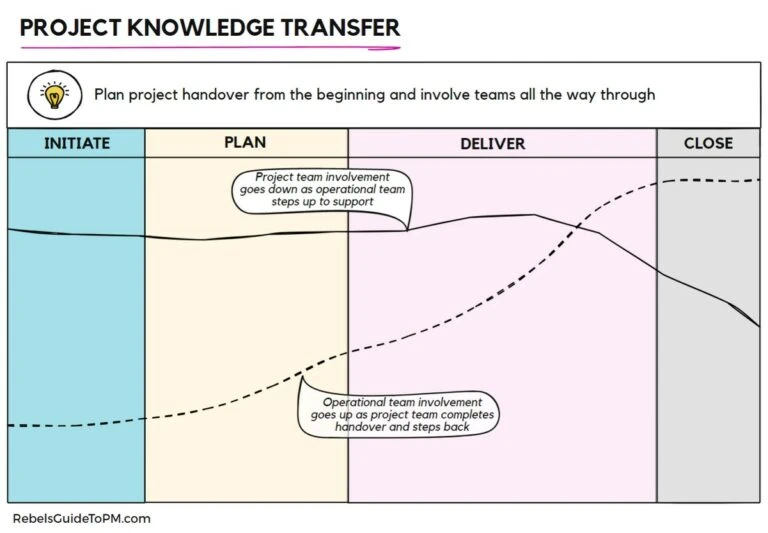
Closing a project is more than announcing completion (if you hadn’t guessed already!). It’s a structured transition from project work into operational ownership. Formal closure ensures deliverables are accepted, documentation is finalized, lessons learned are captured, and benefits tracking is handed over appropriately. Then you can step away and work on another project, safe in the knowledge that the team have somewhere else to go for questions instead of bugging you, long after you’ve moved on to something else.
So effective closure protects long-term value — in other words, being able to realize the benefits that the organization was expecting from this delivery. Without a proper handover, operational teams may struggle to maintain new systems or processes, and go back to old ways of working. Without lessons learned, future projects repeat avoidable mistakes. Both of these undermine the value creation and basically mean your work risks being a waste of time.
A disciplined closing phase allows the organization to confirm outcomes and get them signed off by everyone, archive documentation, release resources, and formally conclude the initiative. It creates a clear endpoint and enables teams to move forward without lingering obligations. And suppliers get paid at this point, and all the finances are shut down too. No more time tracking or invoices! At least, not for this project!
Explore the resources below to get started!
-
7 Easy steps I use to close a project effectively (Steal my checklist!)
Learn how to close a project in 7 simple steps. This infographic walks you through what’s required to shut down your project effectively and efficiently with less stress and more customer satisfaction!
-
How to handover a project on closure
Handover a project in 4 simple steps! Learn how to identify who to handover to, what project artifacts to handover and how to host the meetings.
-
Lessons Learned in Project Management
Tips on capturing lessons learned in project management including templates that you can use on all of your projects.
-
What to do when your project closes early: A guide
Learn what to do when your project closes early with this guide. Get tips on assessing the situation, developing an action plan, and evaluating results for future success.
-
A Guide to Project Closure: 12 Essential Things To Do
Here is a checklist of 12 things that you should do during project closure to make sure the work is wrapped up efficiently.
-
How to Improve Problem Solving with Lessons Learned
Expand your problem solving toolkit by using your lessons learned log to uncover potential problems.





Project lifecycle tips on YouTube!
If you prefer a visual walkthrough of the project lifecycle, this playlist explains more about the topic in practical terms. On YouTube, you’ll find videos that break down key activities, decision points, and common pitfalls across initiation, execution, and closure.
Here’s a collection of videos from me and some of my favorite creators on the topic of managing the project lifecycle, so have a browse through.
FAQ about managing the project lifecycle
Here are the questions I get asked the most often! From technology to task lists, these things come up in my mentoring sessions time and time again.
What are the phases of the project lifecycle?
The project lifecycle typically includes initiation, planning, execution, monitoring and controlling, and closure. While terminology may vary by framework, most projects follow a structured progression from defining objectives to delivering outputs and formally closing the work.
Why is the project lifecycle important in project management?
The project lifecycle provides structure and control across a project’s duration. It ensures that objectives are defined, risks are managed, progress is tracked, and deliverables are formally accepted. A clear lifecycle reduces ambiguity and improves governance.
What happens during the execution phase of a project?
During the execution phase, project teams complete planned work, coordinate resources, manage risks, and report progress. It’s the ‘doing’ stage of the project, whether you are using agile methods or a more traditional predictive approach to delivering the work.
Monitoring and controlling activities (like performance management and reporting) happen at the same time, in parallel, to ensure the project remains aligned with scope, schedule, and budget baselines. You can course-correct if you notice the work is drifting from what you agreed.
What is project closure in the project lifecycle?
Project closure is the formal process of completing and transitioning a project. It includes obtaining acceptance of deliverables, documenting lessons learned, finalizing contracts, archiving documentation, and handing over outputs to operational teams. And don’t forget a team celebration to mark what you have achieved!
Can the project lifecycle vary by methodology?
Yes, the project lifecycle can vary depending on the framework or approach used. Predictive methodologies often follow defined sequential phases, while Agile approaches use iterative cycles. However, all projects move through some form of start, deliver, and close structure.
Other project lifecycle articles
Below you’ll find the full collection of articles related to managing projects across the lifecycle. These resources explore initiation documents, scheduling, monitoring and controlling techniques, governance, reporting, handover, and lessons learned. Phew!
The archive connects strategic planning with day-to-day delivery practice. Whether you are refining your initiation process, strengthening execution controls, or formalizing closure procedures, this content supports structured and repeatable project management.
-
Making the Difference: Problem Solving vs Decision Making
Discover the difference between problem solving and decision making. Learn when to use each, who is involved, and how to make the best decisions for your project.
-
Project decision making: a guide for doing it better
In this article, I will provide more detail on a framework for better project decision making in an effective, rational and ethical way.
-
7 Hidden dangers of project management (Or why even well-planned projects sometimes fail)
Despite your efforts to clearly define the scope, time and resources necessary to successfully complete the projects, things simply don’t always go according to plan. Here are 3 examples of projects that didn’t go to plan. During a company integration program, customer service levels dropped by 25-50% because the team management focused their efforts on…
-
How to Recover A Troubled Program
Learn how to implement a project recovery plan to deal with troubled projects and programmes. This 5-step approach will get your projects back on track and could save you from a failed project by finding ways to get some value from what’s happened (even if you can’t recover the project totally).
-
Get Your Project Overview Statement Right: Tips and Tricks
Tips and tricks for writing an effective project overview statement that will help your project succeed.
-
The Impact of Framing in Decision Making
Read on for more information about the impact of framing in decision making and what you should do about it.