5 Common Change Models and How Useful They Are at Work
Project managers deliver change all the time, but in my experience, we aren’t always focused on the change side of change… if you see what I mean.
Project managers tend to focus on the delivery and execution, and hopefully there’s a change manager who picks up the impact on the end users.
But if there isn’t, then you need to spend at least a little time on making sure your project changes land well. Employees experience change in different ways: some embrace it, while others resist.
Whether it’s a new software rollout, a company restructure, or a shift in business strategy, change requires people to adapt both emotionally and structurally. And that can be hard.

Read next: Best change management books
The best change models for project managers
As part of my mentoring training, I looked at some well-known change models: Kubler-Ross, Bridges, Lewin, and Kotter, and their relevance to workplace change. I’ve also previously looked at the McKinsey 7-S model, so that was a useful comparison, included below. While some models focus on the emotional journey individuals go through, others provide structured processes for leading change successfully.
Both approaches are worth taking into account when you’re preparing for project delivery, because we need to acknowledge that people are emotional beings who also have to change the way they work as a result of our projects.
So, for project managers and team leaders, understanding these models can be invaluable. Knowing more about them can help you tailor your stakeholder engagement and help you decide on management strategies for leading the project.
1. Kubler Ross
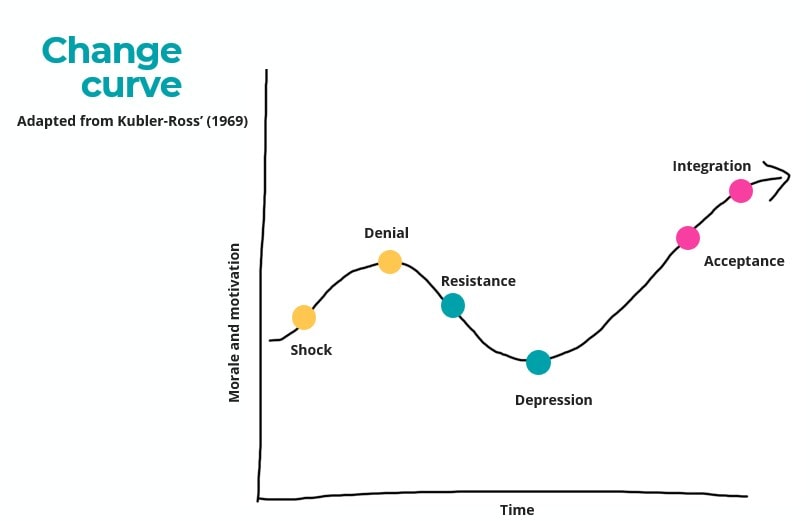
You’ve probably seen the Kubler Ross change curve, it’s the one of the popular
The challenge to the Kubler Ross model is that it was designed for people who are grieving, and therefore they are starting in a very different place to individuals who are going through organizational change. It’s useful, but I think we should review it critically when considering it in the light of personal development.
The Change Curve is the version that is used for organizational change and is based on Kubler-Ross’s work in the 1960s.
It is not a smooth curve because people go through ups and downs in dealing with change and the emotions associated with it. The commonly-acknowledged steps are:
- Shock
- Denial
- Anger
- Depression
- Acceptance
- Integration
This is different from the original work into grief which only had 5 steps, and the change curve seems to have various variations as it has evolved or been put to different uses over the years.
I think people can move through some of the stages quite quickly. Reflecting on this, I did not think that I had personally acknowledged ever feeling denial at work for example, following the shock of an announcement like a redundancy programme, but reading more about it, denial shows up as questioning the decision and thinking that there is no need for change, and I have definitely done that.
Once that stage is passed, people feel suspicious, isolated or worried. It takes time for acceptance and integration and understanding that others feel the same way and that they are not alone is helpful.
Best for: Understanding individual level feelings related to change. However, you need employee feedback to be able to act on it – if no one shares how they are feeling you’re kind of flying in the dark.
2. Bridges Transition Model
Bridge’s transition is similar to Kubler Ross in that it considers the emotional journey people go through.
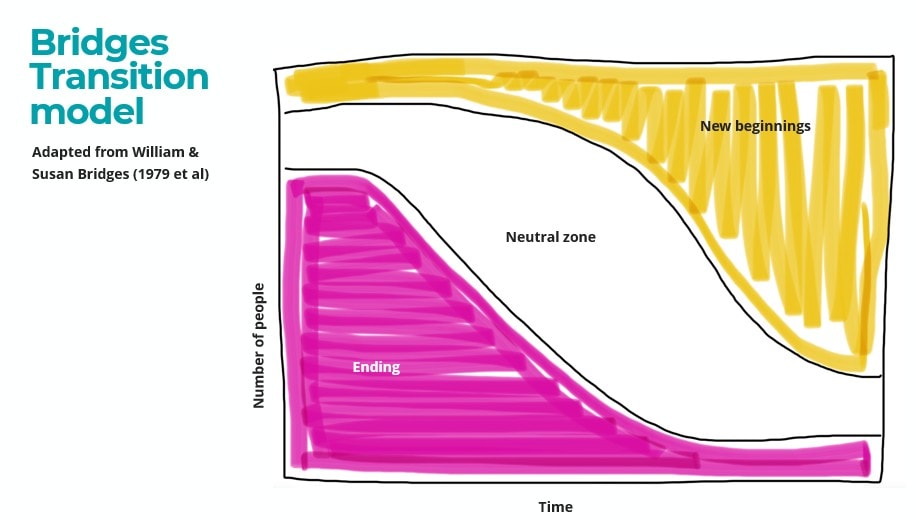
There are three phases:
- Ending
- The Neutral Zone
- New Beginning.
The way the three phases are described graphically in the image below shows that people take different lengths of time to come to the new beginning and accept the change they have been through. Some people never get there.
Example:
When we launched a new software system in my old job, the people who could not get on with it were eventually let go as it was a requirement of their role to be able to operate the new software. This is a final resort, as ideally we would be supporting and mentoring people through the change so they come to the new beginning in a reasonable amount of time.
What I like about this model is that it makes evident the transition. The change is what is done to people (a new leader, a merger, a process change etc). The transition is the personal journey that people go through to make peace with the change. We can influence how quick the journey is by recognising what has been left behind and supporting people to let go of what has been and manage the confusion and potential distrust of what is coming to land safely in the new beginning.
Best for: I think this works well for large-scale changes like operational restructuring.
3. Lewin
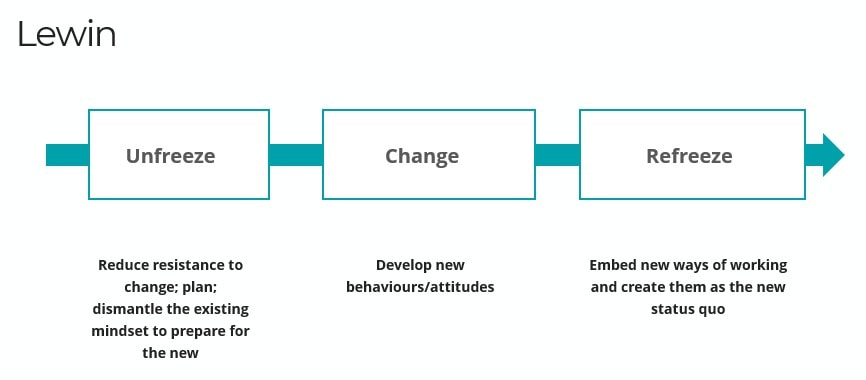
Kurt Lewin’s model is one that is taught in project management but it’s less about the emotional journey that people go through (like Kubler-Ross and Bridges) and more about the process of creating that emotional journey by structuring the experience that people go through.
The steps are:
- Unfreeze
- Change
- Refreeze
I like this as it’s really simple and it shows the need to ‘break’ old behaviours in the Unfreeze stage to make space for the change. The change itself is surrounded by activities that support behaviour change to ensure people are brought along with the change.
Best for: I think this approach works well for continuous improvement. You can use it on a small scale to talk about incremental changes.
4. Kotter
Kotter is an 8-step change management approach that again focuses on the process for an organisation to deliver change rather than the emotional journey that an individual experiencing change goes through.
However, it does prompt reflection and action on the personal experience as part of the process as without that, the change will most likely fail. It’s a very structured approach.
The steps are:
- Create a sense of urgency
- Build a guiding coalition: this is a network of super users or change champions
- Form a strategic vision: I think it’s important to do this first actually, as otherwise what are you creating a sense of urgency about?
- Enlist a volunteer army: this step is about empowering people to rally around the opportunity and decide actively to commit and contribute to the change. In my experience, we don’t always do this because we aren’t creating the kind of change that needs a grassroots movement to support it.
- Enable action by removing barriers
- Generate short-term wins: in our projects, we do try to have short-term wins because they keep momentum going and create stories that we can share to encourage others or to continue the support for the project.
- Sustain acceleration: this is just doing more of the same so you get more wins.
- Institute change: this is about embedding the change so it becomes ‘how we do things around here’ and the normal ways of working.
I think Kotter’s 8-step change model is worth knowing but feels over-engineered for most small scale project change.
For project team members, it’s probably a bit overkill too, as individuals would be part of the organizational change but aren’t typically leading it so would not be working through these steps. It’s got to be led at organizational level.
I think you’ll need strong commitment to this as a leadership approach with buy in from the top if you want to adopt Kotter in its purest sense.
Best for: Kotter is useful for addressing employee resistance and changing company culture.
5. McKinsey 7S
When it comes to project management things can move really quickly, and sometimes that means things get out of hand. When you’ve got a lot to do, ensuring that your project is aligned to your organizational goals becomes even more important – it’s too easy to let slip that strategic alignment that we have heard so much about in the project management press over the past year or so.
Staying on top of everything and staying aligned to the organizational goals is easier with the tools and techniques to help you. This is where project management methodologies, models, techniques and task management software comes into play. They streamline your tasks and keep you on track to achieve success.
One of those models is the 7-S framework, a tool for understanding the complexities of your organization so you can better understand the change impact.
Introduced by thinkers at McKinsey in the 1970s, it was a revolutionary way of thinking about how organizations worked. Previously the focus had been on hierarchy and the physical structure of a firm.
The 7-S model focuses more on coordination through a connected web of factors that affect how an organization is able to work and change.
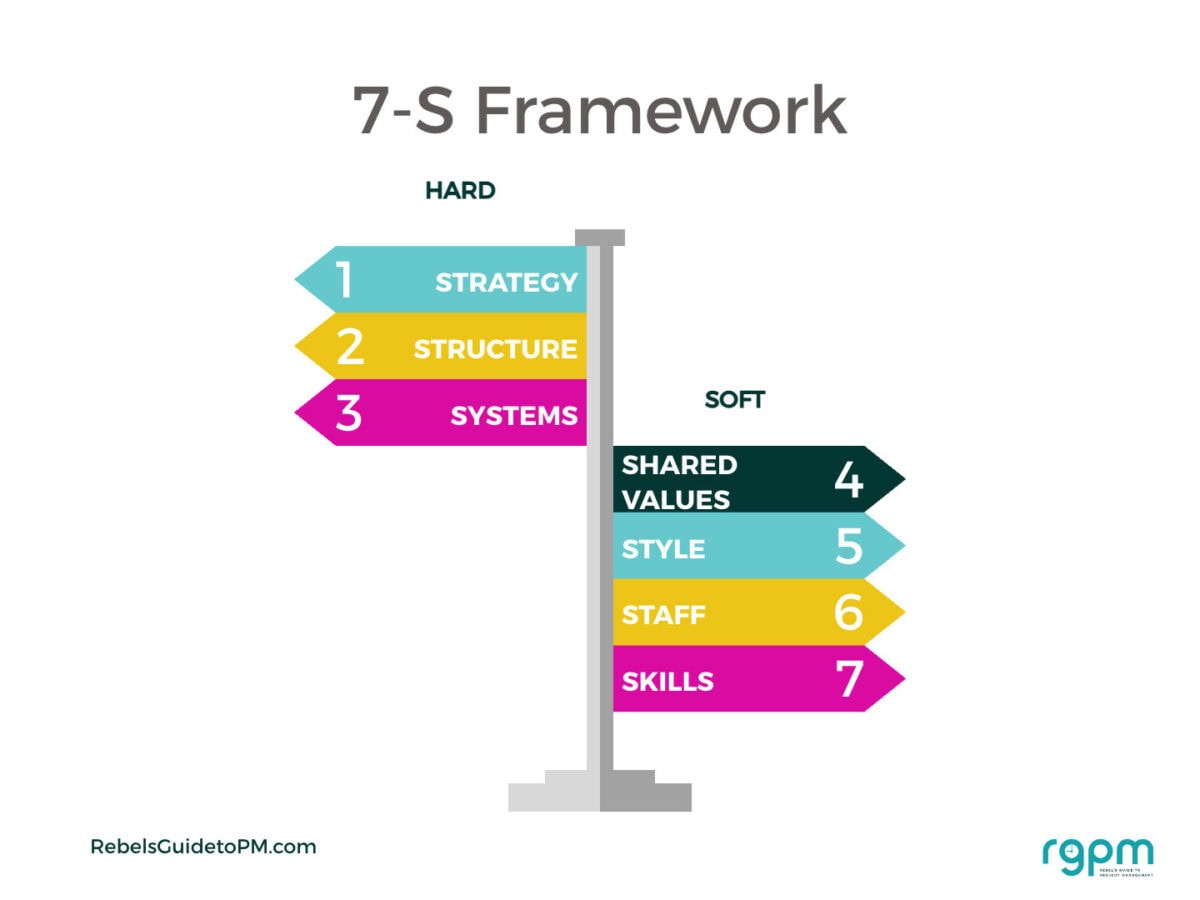
The 7-S framework wasn’t designed with project management particularly in mind, but it is useful in determining how aligned your project goals are with your organizational goals and what needs to be done to improve the correlation further.
The framework breaks down into – surprise! – 7 categories, split into hard and soft elements.
Let’s look at those with a particular focus on how they relate to project management.
Hard Elements
The hard elements cover three factors: Strategy, Structure, and Systems.
Hard elements are easier to identify, define and understand for project managers because these factors hugely influence your projects. You’ll be using them every day.
Everything from formal processes, strategies, reporting, organizational charts, and IT systems falls under this category.
1. Strategy
Setting project objectives is not enough to achieve success. You should have a plan and strategy about how to be successful and how to achieve your objectives.
The project plan and strategy should be well documented and communicated to all team members. The project strategy should focus on how to build and maintain a competitive advantage over the competitors. Strategy can change with changes in situation and external environments: most likely your project sponsor and project board will steer your work here.
2. Structure
This element relates to who will report to whom. Organizational charts for your project and other related resource documents fall inside the Structure element of the 7-S model.
Irrespective of the project scope of the implementation, it is important that you and your team members are clear about who reports to whom.
A roles and responsibilities chart can also help, or a RACI matrix. There are lots of ways to make sure project structure is clear.
3. Systems
The System element reflects how the tasks will be completed and what process will be followed. It covers areas related to business operations and the business of running projects.
Systems can include project management software and collaboration tools, but are also broader than that: the processes, formal and informal ways of working that get things done in your organization.
As a project manager, you probably spend a lot of time removing bottlenecks for your team to ensure they can fulfil their responsibilities and achieve better results. That’s all systems work.
Soft Elements
There are four Soft elements: Shared Values, Style, Staff, and Skills.
Soft elements are difficult to quantify and are heavily dependent on the organizational culture, making them much harder to put into practice successfully in a project environment.
4. Shared Values
Shared values are the first soft element that deals with organizational culture. It is the shared values that bind the project team together and foster cohesiveness and teamwork.
These characteristics run deep down the organization; companies never let go of them, no matter how grave the circumstances. Both the corporate culture and general work ethic also reflect shared values.
You may have posters up in the office or a screensaver that puts company values front of mind. Or you may just get a feeling of ‘that’s the way things are done around here’.
5. Style
This element relates to leadership style. The leadership style you adopt as a project manager will directly influence your team. It’s important that you select the style carefully (the situational leadership model will help here) after assessing the situation to choose a response that will get the best out of the situation and the team members involved.
Flex your leadership style as your project requires.
Read next: How to delegate tasks
6. Staff
People are the most valuable assets of a company. Managing your staff efficiently and getting the best out of them is the core responsibility of a manager, and even project managers without line responsibility for their teams have a huge influence over the individuals involved in the project.
Get to know your team so that you can help them develop their skills and provide them with the opportunities where they can grow as a professional.
This will also help you in retaining your best talent and reducing the employee turnover rate.
7. Skills
Closely related to the previous point, the Skill element of the 7-S model focuses on the number of skills and levels of skills your team members have. Good project managers spend time with every individual to get to know them better and evaluate their skill levels.
That goes for you as well: project managers should invest in their own personal development through training programs, workshops, seminars, and visits. In today’s dynamic and competitive world of project management, you should always look for opportunities to learn new things in order to compete with your competitors.
Investing in development activities for yourself and your team can reap rewards in future. It will help you in getting most out of your employees in the long run. And give your all some extra project management skills for your resume.
6. Prosci: ADKAR
The ADKAR® model from Prosci is part of Prosci’s wider change management methodology and remains a go-to way to structure organizational change for many companies.
ADKAR stands for the five outcomes on an individual basis that people need to achieve for a change to be successful: Awareness, Desire, Knowledge, Ability and Reinforcement.
- Awareness: They need to know the change is happening (obviously)
- Desire: They want to get on board with the change (resistance and unwillingness to change is the blocker here)
- Knowledge: They need to know how to change (e.g. through training, using a new process, behaving differently etc)
- Ability: They need to have the skills necessary to ‘be’ the change (e.g. completing their training, having the right resources available etc)
- Reinforcement: They need ways to help them sustain the change (which could be acknowledgement and incentives for doing things the right way or negative consequences for doing things the old way).
I love the ADKAR model and I know it’s last on this list but it’s ‘famous’ for a reason. There’s obviously a lot to the model and you can go on a training course and become an accredited practitioner in Prosci’s methodology, but even that quick summary above can be a springboard to using this powerful method.
Best for: Planning large-scale transformations and identifying resistance to change.
Practical ways for project managers to use these models
Here are some ways that you can use these models in real life as part of project management process, in your role as a change agent.
Offer perspective
Sometimes I have been through a similar change in the past. One of the steps in Kubler-Ross is the anger/depression stage and it can help people get through that stage if they know that others are feeling the same way. It’s a way of acknowledging the human response.
If I can share my personal perspective as a mentor or project team leader (of this change or a similar change I have been through previously), it may help my colleagues realize that they are not alone — their emotional responses are completely normal.
Offer a safe space to reflect
People might not be open to talking to business leaders about what’s bothering them, but they might talk to you.
I had an email exchange with a colleague recently and she had been offered a new job and wasn’t sure if she should accept it. I emailed her back some reflection points about the commute, sense of community, what it might mean to go part time so she could consider those.
A big change on a personal level normally needs some time for reflection and as a trusted colleague, I can be a sounding board for project team members or mentees to talk through their reflections in a safe space, if they prefer to do that rather than reflecting alone.
You can also help people reflect on their skills and the area in which they would like to develop. While mentoring another colleague, we’ve talked often about career progression and what her next steps might be, and now I have an insight into where she wants to go, I can help her uncover the skills that would let her be a success in that future role.
Offer direction
When people need a clear route forward through the change, as a change leader, you can offer clarity. For example, if a colleague is struggling, you can say, “Have you thought about bringing that up with your manager/going on that training course” or something similar.
This could help a colleague with a smooth transition to whatever the new ways of working might be.
Offer knowledge
Sometimes given the project leadership role you have, you’ll have access to information that others don’t have. For example, I was able to connect a project team to the appropriate operational expert who needed to sign off on the work before it went live, as they weren’t aware of that required step.
Even small things like that can help with successful change management for your project. Remember, these
Theory is only useful if implemented
It’s likely that these elements in any framework aren’t new to you, although the actual wrapper of the approach might be. They all form part of the competencies expected of project managers.
The problem lies in implementation. Are you really using all these elements to help drive project success? Or did you just write about them in the Project Charter or terms of reference and then let the principles slip a little?
If you want to achieve your project goals (or any organizational goal), then it’s important that you focus both on the hard and soft elements of your chosen change management approach, giving them all equal importance. Ignoring the soft elements in particular can wreak havoc on the chances of project’s success and has the potential to negatively impact organizational culture over the long term.
All these models require you to actively plan out steps, for example scheduling training and support for colleagues and making sure stakeholder involvement is where it needs to be. It’s also worth looking at nudge theory if you want an angle that requires very little effort to help people move in the right direction (as long as your outcomes lend themselves to nudging people in a certain direction, ethically).
Make it work for you
Looking to put one of these change management strategies into practice? Here are some steps to take now.
- Think about your professional development in this area. Schedule in some time to watch one of my free project management webinars (which also count towards your CPD/
PDU requirements for professional certifications). - Download a free organizational chart template so you can start to document the hierarchy of your project (relevant for 7-S).
- Learn what should be in a project plan (there are free templates included in that article too).
- Review your project charter and see if it could be updated in light of the model you have chosen to use.
FAQ
Which change management model is most effective for large-scale transformations?
Personally, I would use ADKAR, the Prosci proprietary method. It’s takes you through the change process step-by-step including the important activity of building change champions. This is great if you’re doing large-scale transformations and need wide buy-in for the project.
What are the different types of change management models?
There are 3 main types of change management models: process based (e.g. Kotter, Lewin), people-focused (like Kubler-Ross, ADKAR) and system-based (e.g. the McKinsey 7S). Use whichever works best for your situation.
What are the most popular change management models used in organizations?
That depends on what you are trying to achieve. If you’re looking at the potential effects of large-scale organizational change, 7S is going to help. If you want a tried-and-tested way to step people through a restructure or a significant transformation, ADKAR gives you the process. If you want a way to hone in on the people impacts and talk to people about how they feel, I’d be sharing Kubler-Ross with them.
