20 Practical tips to get (and stay) organized at work
Being disorganized can cost you up to 14 hours per week. Here are 15 proven tips to stay organized at work.
Productivity is not about doing more. It is about doing the right work, at the right time, with enough headspace left over to think clearly. For project managers, that balance is critical. You are juggling stakeholders, deadlines, risk, budgets and people (and let’s not mention office politics and expectations). Without strong time management and healthy boundaries, it is easy to feel permanently behind — trust me, I’ve been there, and so have most of the project managers I mentor.
This collection of articles explores practical ways to improve personal productivity, organize your work, manage competing priorities and protect your work life balance. Whether you are running one project or many, these techniques will help you feel more in control and less reactive. My goal is always to help you get more work done and still leave the office on time!
Being organized is not about colour-coding your inbox (unless that genuinely helps). It is about creating systems that reduce friction and free up cognitive load. When you know where information lives, what your priorities are and how your week is structured, you make better decisions and avoid unnecessary stress.
The right ‘personal work management’ system for you is going to look different to what works for me. So use the articles across RebelsGuideToPM as a starting point for your own planning and experimenting. For example, I couldn’t find a note-taking and personal action tracking system that worked for me so I stuck with notebooks for a long time, but I have switched now to OneNote which works a lot better for the team. I still keep my personal To Do list in my notebook, and team actions are tracked in an action log.
To feel productive and organized at work, you need to:
• Set up task management systems that work in real life
• Prioritize effectively when everything feels urgent
• Structure your week to protect focus time
• Manage email without letting it manage you
• Use simple frameworks to decide what to work on next.
My most popular articles on these topics are below, but there is lots more guidance on the website – use the search function to find what you need, as I’m sure someone has asked the same question as you before!
Personal organization and knowing your best ways of working complement formal project management processes such as work breakdown structures and scheduling, but they focus on you as the individual delivering within that system. In other words, personal productivity underpins professional performance, so get that right, and your projects will suddenly feel easier!

Being disorganized can cost you up to 14 hours per week. Here are 15 proven tips to stay organized at work.
Where do you start when you want to work smarter? Here are 5 ways to flex how you work for more productivity and to fit your lifestyle more effectively.

Make it easy to get ready for next week and hit the ground running at work on Monday with these tips for planning ahead. Use Friday afternoon to sort out your inbox and check your upcoming appointments so you can really enjoy the weekend.
In my experience, projects have busy and slower times. Typically, the workload for project managers is intense at the beginning of a project and when you are working towards a big deadline, milestone, go live or decision point. While the ‘doing’ is happening, the doers are working away and there should be a lower project management overhead for you — unless there’s a problem or issue you need to resolve, it should be more about maintenance and checking progess is happening.
The key to managing your work/life balance is to identify when you are going to be more busy and plan as much as you can in advance for those times, so it doesn’t burn you out. Get ahead (whatever that looks like for you) during the slower times.
Staying motivated can also be a struggle when you’re feeling overwhelmed and on the edge of burnout, so watch for that, and if you need to plan in a slower day to get your energy back, do it.
Below, you’ll find my top articles with practical advice on how to talk to your manager and get yourself back on track when you’ve got too much work, how to make sure you’re getting time for work and balancing the many needs of the festive season, and some guidance from real project managers about how they do it.

Learn just what to do when you have too much work (even when you can’t admit it to yourself).

I’m sharing my tried-and-tested productivity hacks for project managers to get through the festive season without worrying about work.

6 real project managers share their tips for getting a work/life balance. Read on to find out how you can use their tips to get more time, delegate more effectively and reframe your priorities to do more of what matters.
Productivity is going to look different for everyone, but what it feels like is getting to the end of the day and feeling like you’ve had a good day and made progress on your To Do list. You’ve unblocked something, sorted something, moved forward. You can see the difference you’ve made. It feels like you’ve spent time on ‘quality’ work.
That could be updating the project timeline, sorting out an issue with resource allocation, clarifying project objectives with the team so you’re all pulling in the same direction, blocking out some time for creativity, blitzing some items on your risk management list, or going through the continuous improvement ideas and planning something to implement next quarter.
And sometimes even spending the day talking to stakeholders before a big meeting to get alignment on a critical decision is what it takes — it might not feel like you’ve done a lot, but you will have made a difference for Future You!
There are lots of productivity hacks, tips and tricks to help you feel like you’ve had that kind of day, and I’ve shared a few of my own below.
Explore the resources below to get started!

Discover 17 examples of productivity that will help you get ahead in the office. Learn how to establish a routine, utilize technology, work in teams, manage stress levels and stay motivated and focused.

Here are 5 free options for staying on top of your email management and keeping tasks out of your inbox. These email management tips and tricks will help you get control of your inbox for good.

Becoming a mum helped me to realise that I was not transitioning between tasks all that well. Here is what I learned about work/life integration and how I’ve improved my day.
Here’s a collection of videos from me and some of my favorite creators on the topic of managing your time as a project leader, so have a browse through. They could help you and your team members reframe what project productivity looks like for you!
I’d also suggest checking out the channel from the vendor of the project management software that you use, as learning a few tips and tricks for using your tools will also reduce frustration and speed up getting your work done.
Here are the questions I get asked the most often! From technology to task lists, these things come up in my mentoring sessions time and time again.
The best productivity tips for project managers are those that focus on prioritization, planning and protecting focus time. Start by identifying your top three outcomes for the week and align your tasks to those. Use time blocking to protect space for high-value work such as planning, risk reviews and stakeholder communication. Limit multitasking, batch admin tasks like email, and build short review points into your week to adjust priorities. Productivity improves when you reduce decision fatigue and work intentionally rather than reactively!
Managing multiple projects without burning out requires realistic capacity planning and strong boundaries. Break down work by project, identify peak periods and avoid overloading the same weeks with major milestones. Escalate resource conflicts early instead of absorbing pressure yourself. Protect non-negotiable downtime and avoid becoming the default escalation point for everything. Burnout often stems from unclear priorities and unmanaged expectations rather than volume alone.
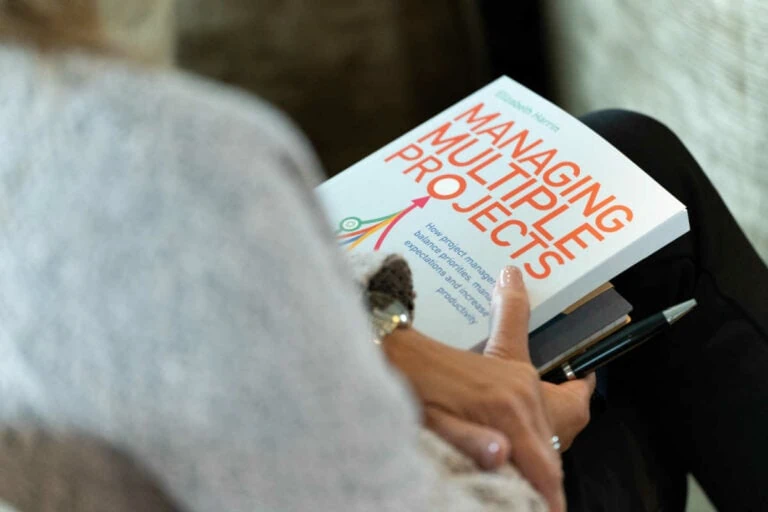
For more on this, read my book, Managing Multiple Projects: How Project Managers can Balance Priorities, Manage Expectations and Increase Productivity (Kogan Page).
Time management is about how you allocate and protect your hours. Productivity is about the value you create during those hours. A project manager can manage their calendar perfectly but still spend time on low-impact activities, so their projects don’t move on as quickly or feel as under control as another project manager’s.
True productivity means focusing on tasks that move the project forward: clarifying scope, managing risk, resolving dependencies and supporting the team. Good time management supports productivity, but they are not the same thing.
Productivity tools can support task tracking, calendar management and documentation control. Examples include digital task boards, time blocking in calendar systems, shared document repositories and simple automation tools for repetitive admin tasks.
The most effective software is the one that fits naturally into your workflow and reduces friction rather than adding complexity. That could be Teams, Slack, Jira, Google Suite and of course AI companions like Copilot, Claude Cowork or ChatGPT, as long as these are sanctioned by your workplace.
Below you’ll find the full archive of articles related to how to make the most of your hours at work. This includes in-depth guides to advanced techniques, practical walkthroughs and lessons learned from real-world projects.
Use these resources to deepen your understanding of your personal ways of working and preferred styles and tools, then try out some approaches to see what works best for you.

“A perfect project plan for regular, light-touch steering should contain no more than five milestones,” writes Graham Allcott in his book, How To Be A Productivity Ninja. “Too often, milestones become micro-management or seem to provide complication and confusion rather than clarity. So in each of your projects, you should look for between one and…

Six women share their tips for making a comeback at work after maternity leave. Research shows women can lose their earning power when they take time out to have children, so planning your return to work (as far as you can) will make you feel more confident about turning up to the office again.

As regular readers will know, I’ve been on maternity leave since January, and I’m now easing myself back into work. I spoke to Janice Haddon, a coach and management consultant who specialises in helping people return to work successfully (amongst other things). This is what she had to say about returning to work after a…
These 5 tips will have you managing your workload and creating your perfect work/life integration. Find out how to deal with constant stream of information in your job. Learn how to manage your interruptions for work/life balance.
Last week, the BCS’s Project Eye blogged about the low numbers of women entering science, technology, engineering and maths (STEM) to pursue careers. Project and program management is still required in this fields – so given that women choose project management as a career, why aren’t they choosing it in STEM areas? I’ve teamed up…

The Arras People 2011 Benchmark Report is out – and the study shows some interesting facts about pay. Pay for female project professionals peaks at the £30k to £40k salary band. Salaries for women over £65k are rare, and only 15% of women earn over £50k. Male salaries plateau between £30k and £50k with 47%…

2011 marks the 100th anniversary of International Women’s Day. Today, people all over the world are celebrating the economic, political and social achievements of women past, present and future. And they are also eating pancakes, as this year IWD falls on the same day as Shrove Tuesday. Women have an important part to play in…
“What about Facebook for project managers?” is a question I’m asked a lot when I talk to people about social media tools for project managers. As you know, I’m a big believer in the benefits that social media tools can offer project managers. But when I’m asked about Facebook I always say that I don’t…

In this video, you’ll go behind the scenes at the podcast I recorded earlier this year with Paul Naybour from Parallel Project Training, Lindsay Scott from Arras People and How to Manage a Camel and Owain Wilson from the Association for Project Management. This is an extract of our morning as we were experimenting with…

Today, Andrew Filev, who writes the fab Project Management 2.0 blog, and I are swapping posts. We agreed on the loose topic of social media and project management. Andrew has a great deal of knowledge on enterprise 2.0 and social media, so I’m glad to have him as a guest author today. You can read…

Don’t arrive hot and bothered. It’s OK to take off your coat and jacket on public transport. Honestly, you don’t have to sit there baking, although people on the Tube seem to think there are laws against undressing.* Know where you are going. That means maps! And/or an accurate postcode for GPS. Plus phone number…

10 Easy tips for keeping your workplace tidy and making you more productive. Put these into practice and you’ll soon be saving time each day and feel more positive about your space.